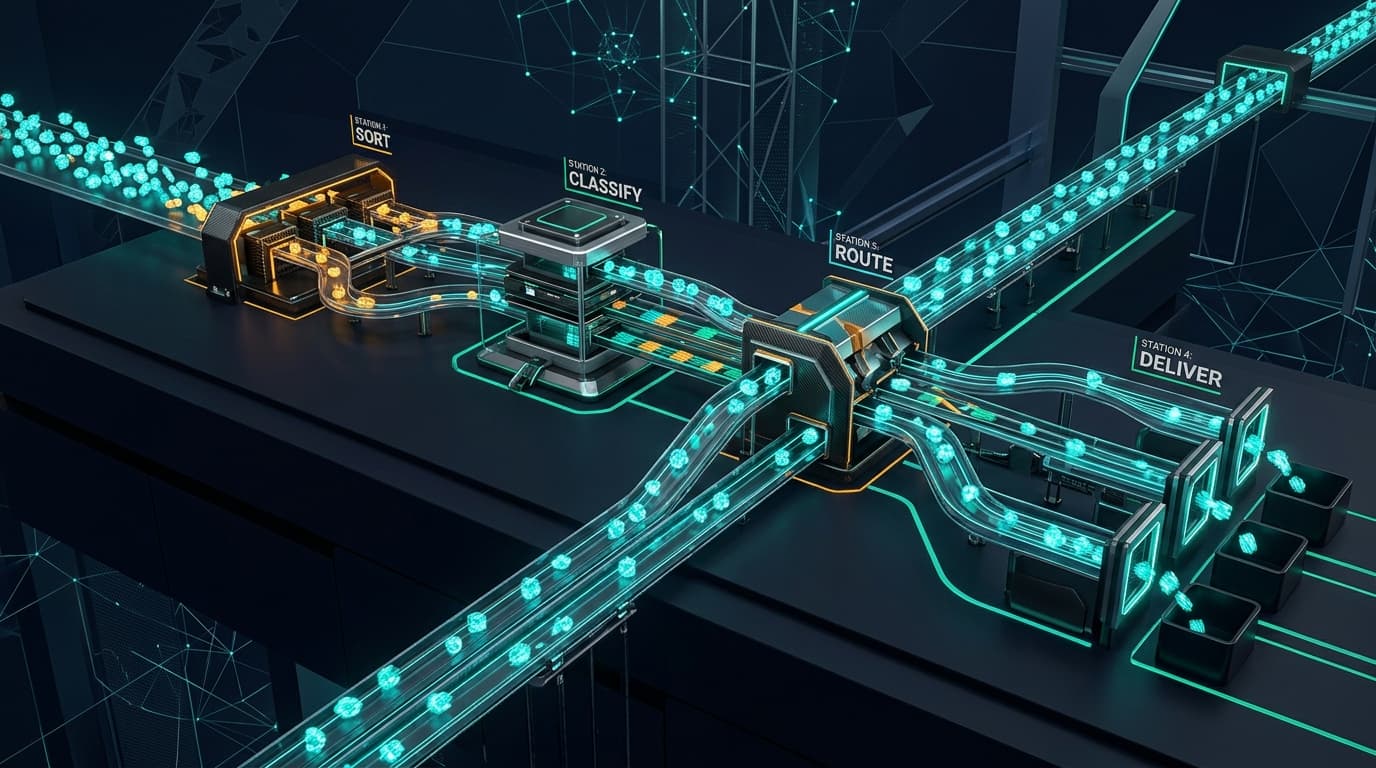
Most operations advice is "hire your way out." That works until it does not. Hiring to solve an operations problem is like adding lanes to a congested highway — six months of relief followed by the same congestion at a higher burn rate. We learned this running 9 venture lines on a small operating team. The way out is not more headcount; it is fewer manual steps.
Key Takeaway
Assume every recurring process should be automated until proven otherwise. That single shift in default flips the burden of proof: instead of asking "can we automate this?" you ask "why does a human still do this?" The 6-week sprint below is the structure we use to find, prioritize, and ship automations across our ventures.
The Problem
The default response to growing operational complexity is to hire. It feels like progress; the dashboard turns green; the founder feels relief. Three months later, the new hire is buried in the same workflow that swamped the original team — except now the team is bigger, the communication overhead has multiplied, and the [unit economics](/insights/pricing-architecture-how-to-set-prices-that-scale) have worsened.
The root cause is treating tasks as the unit of work. Tasks done repeatedly by humans are systems waiting to happen. Until the system exists, every additional hire inherits the same chaos.
The Framework
01 — Discovery (Weeks 1-2): Map Every Recurring Task
What we look for:
- Granular task inventory at 30-minute resolution for two consecutive weeks
- Task description, frequency, time per occurrence, systems touched, error rate
- Honest data — not an estimate, the actual time logged in the moment
- Categories: repeatable / requires-judgment / candidates-for-automation
Why it matters: Most automation efforts fail before they start because the team skips the audit and jumps to tools. They automate what is easy instead of what is costly. The audit feels slow precisely because it pays back exponentially. We do not move past Week 2 without a complete inventory.
02 — Design (Weeks 3-4): Prioritize Ruthlessly
What we look for:
- Each task scored on Frequency, Time, Error Risk, and Complexity
- A handful of highest-impact processes that account for most of the operational pain
- Clear target state for each: what does the workflow look like after automation?
Why it matters: A small number of processes cause most of the manual time loss. Automating everything is the wrong goal. Automating the right things is. We pick the highest-priority three-to-five, design the target state, and explicitly defer the rest to the next sprint.
03 — Deploy (Weeks 5-6): Build, Test, Monitor
What we look for:
- Success notification on every automation
- Failure alert routed to a named owner
- Audit trail of what ran when
- Documented manual fallback for when the automation fails
Why it matters: An automation that fails silently is worse than no automation. The first time a workflow drops a customer, the team rediscovers why monitoring matters. We add monitoring as part of the build, not as an afterthought. Every automation has an owner. Ownerless automations are deletion candidates at the next audit.
Implementation Checklist
- Two-week task inventory across the team feeling stretched
- Score every recurring task on frequency × time × error-risk × complexity
- Pick the top three-to-five by score; defer the rest explicitly
- Build with monitoring and a manual fallback documented from day one
- Monthly review cadence on every active automation
What This Produces
- Recovered hours that were previously spent on tasks no human should have been doing
- Lower communication overhead because the system handled the handoffs
- A documented operating layer that survives team rotation
Common Mistakes
- Skipping the audit. Jumping to tools before the data is collected automates the wrong thing efficiently. The audit is the work.
- Automating to celebrate. Easy automations exist; impactful automations are usually harder. Score by impact, not by ease.
- No monitoring on critical workflows. A silent failure is worse than no automation. Build the alert before you ship the workflow.
- Treating the sprint as a one-time event. The 6-week cycle is not a project you finish; it is a cadence you repeat. Processes that were correctly left manual in Month 1 become automation candidates in Month 6 once volume changes the math.
Next Steps
If you have a team that feels stretched, run the two-week audit before opening a job rec. Our free training on execution systems walks the sprint end-to-end. To see how we deploy automation across the portfolio, explore the ventures.
Arena-forged across 9 venture lines. The framework above is what we run inside our own operations before it reaches a partner. See Bayanihan Harvest for the proof.
The workflow platform underlying most of what we describe here is documented at n8n's official docs.