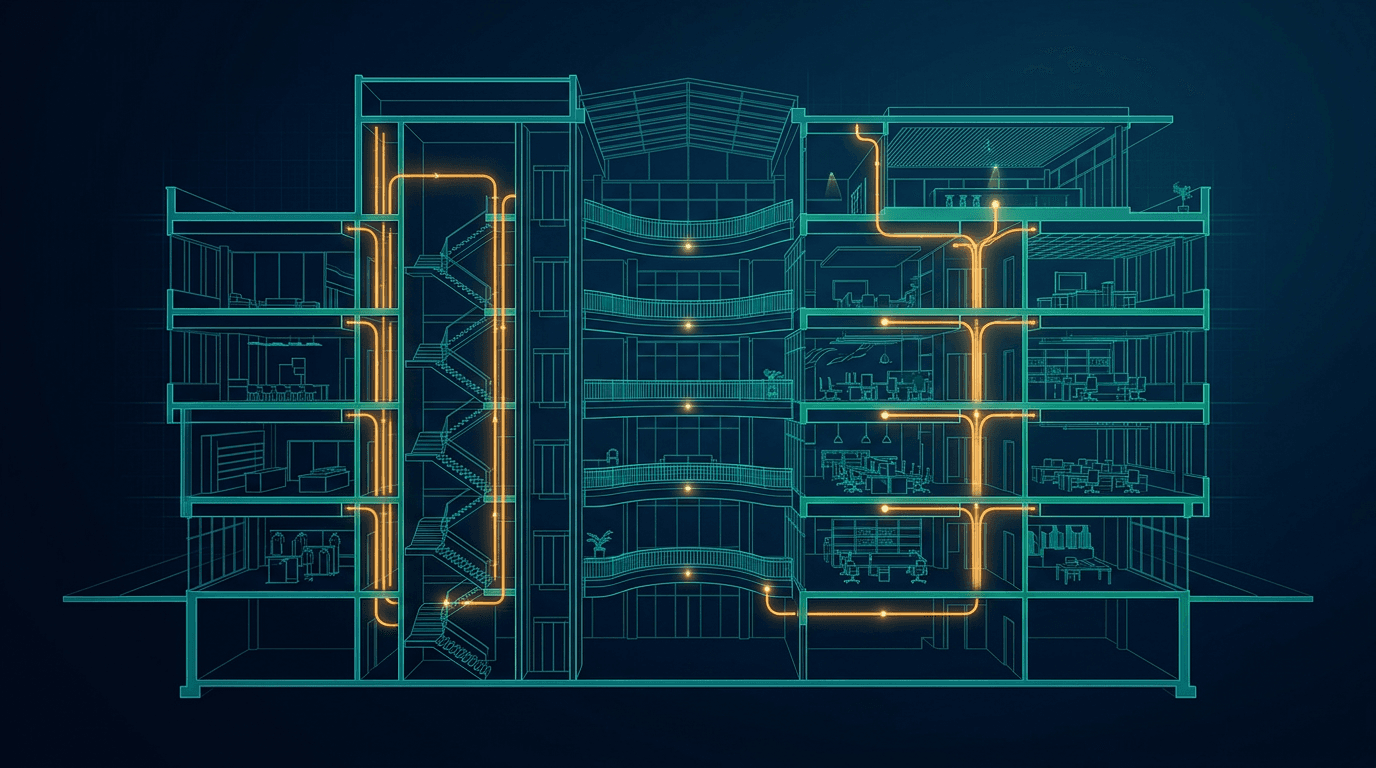
Most founders treat revenue like a scoreboard. They watch it, hope it improves, react when it dips. The problem with a scoreboard: it tells you the score after the play is over.
The companies that compound treat revenue like infrastructure — built deliberately, with multiple streams, with feedback loops between every component. We learned this running 8 venture lines inside HavenWizards. The ones that scaled had architecture. The ones that stalled had hope.
Key Takeaway
Revenue is the output. Architecture is the asset. A company with one channel and one offer is a venture with one engine — fine until the engine misfires. A company with three engines (acquisition, monetization, retention) wired into a feedback loop compounds. We deploy this model across every HavenWizards venture line.
The Problem
Single-channel growth is fragile. We have watched ventures (our own and partners') hit a place where one channel — paid Meta, one referral source, one platform — produces most of their new revenue, then discover what happens when that channel changes its rules. Recovery takes months if it happens at all.
The fix is not "diversify acquisition." That is a tactic. The fix is to architect three engines — acquire, monetize, retain — that are independently measurable and structurally connected. When one slows, the others carry the weight.
The Framework
01 — Acquisition Engine: Real Attribution, Not Blended Numbers
What we look for:
- More than one channel above 20% of new-revenue mix
- CAC measured per channel, per segment, per cohort — not as a blended number
- Documented sales/onboarding process measurable end-to-end
- Feedback loop from closed deals back into the channel that produced them
Why it matters: A blended CAC hides which channel is healthy and which is bleeding. Across our ventures, the per-channel breakdown almost always reveals one channel doing the work and one channel quietly burning budget. You cannot fix what you cannot see at the right granularity. Run the breakdown at the cohort level — at minimum monthly.
02 — Monetization Engine: Pricing as a Designed Surface
What we look for:
- Tiered offer that creates an obvious next step for an active customer
- At least one expansion lever (usage, seats, add-ons) baked into the pricing surface
- Periodic price review — once a year, minimum
- Evidence the team has lost a deal on price (if not, the price is too low)
Why it matters: Most early ventures underprice and never re-test. Pricing is not a contract you sign once with the market — it is a designed surface that should change as your value clarifies. We re-tested pricing inside Bayanihan Harvest in our second year. The increase did not lose us partners. It funded the systems work that compounded later.
03 — Retention Engine: Where Compounding Lives
What we look for:
- Defined activation milestone the customer hits in the first session, the first week, and the first month
- Health signals tracked per account, with an action triggered when a signal trends down
- Monthly review of churn reasons — verbatim, not categorized into a dashboard until you understand them
- Evidence of expansion within existing accounts — the second sale to an existing customer is the compounding sale
Why it matters: Acquisition is linear: one customer in, one revenue line up. Retention compounds: a customer who stays funds the next year''s growth without paid traffic. We have ventures inside the portfolio where retention does most of the work. The math gets exponential the longer it runs. Skip this engine and you are filling a sieve, not a bucket.
Implementation Checklist
- Map your last quarter of revenue by channel, by segment, by cohort
- Identify the single largest concentration risk (one channel above 50%)
- Define one activation milestone per stage: first session, first week, first month
- Set a price review date on the calendar — annual minimum
- Schedule a 30-minute monthly cross-engine review (acquire / monetize / retain in one room)
What This Produces
- Visible failure modes — when a channel breaks, you know which one and how badly
- Pricing as a lever, not a fixed cost — a re-priceable surface that funds reinvestment
- Compounding from existing customers — second-year revenue that does not depend on year-one ad spend
Common Mistakes
- Reporting blended CAC. It hides the broken channel. Blended is for the board deck, not for operations.
- Treating pricing as a permanent decision. Pricing is a designed surface. Re-test it once a year minimum.
- Tracking churn but never reading the verbatims. A dashboard tells you the rate. Customer notes tell you the cause.
Next Steps
If you are building or rebuilding revenue architecture for a venture you operate, our free training on execution systems walks the model end-to-end. If you are evaluating a partnership where revenue architecture is the bottleneck, see how we deploy this across ventures in the portfolio.
Arena-forged across 9 venture lines. Every framework tested in our own operations before it reaches a partner. See Bayanihan Harvest for the proof.
Graham's "Do Things That Don't Scale" makes the same point about revenue: the first repeatable dollar usually comes from unscalable, hands-on work, not the eventual architecture.